


Received was bit annoyed there was no outer packaging eg paper over box it's in as the box wasn't securely packed a side of the lid had come open. Apart from that still getting used to using it but was pleased with the results on my shirts which I find very awkward to iron using a regular iron, I'm sure with more practice I will get great results in the future.
A simpler way to make fresh juice at home, without the chopping or the complicated clean-up.

Fresh juice has never really gone out of fashion. It feels optimistic, healthy and intentional, the kind of habit people start at the beginning of a new year or at the start of a new routine. Most families who invest in a juicer do so with good intentions. They imagine colourful glasses of apple and carrot in the morning, green blends before school, something quick and nourishing before the day begins.
Yet for many households, the routine does not last. The machine works perfectly well, but it slowly becomes less convenient. The issue is rarely the quality of the juice. It is the effort surrounding it. The chopping beforehand, the supervision while it runs, and the cleaning afterwards are what gradually turn enthusiasm into avoidance.
Self-feeding cold press juicing has gained attention for one simple reason. It addresses those friction points directly.

The Hidden Friction in Traditional Juicing
Traditional juicers often promise speed or power, and many claim to handle whole fruit. In practice, however, most still require apples to be quartered, carrots to be halved and ingredients to be carefully reduced in size before they can pass through a narrow chute. Once switched on, they frequently require constant pushing and supervision, particularly when processing firmer produce or leafy greens.
Centrifugal machines can be loud and produce a layer of foam, while older-style cold press juicers, though capable of producing excellent texture, are sometimes associated with more parts and longer cleaning times. None of these details seem significant on the first use. Over time, however, they add up. Five extra minutes of chopping here, ten minutes of cleaning there, and suddenly juicing feels like a task rather than a habit.
For families, especially on busy mornings, practicality matters more than perfection.

What Self-Feeding Changes
Self-feeding cold press juicers are built around a wider chamber and a more natural ingredient flow. Instead of forcing produce through a tight tube, you load ingredients into a larger chamber, close the lid and allow the machine to draw them in gradually.
You load it.
You close it.
It feeds itself.
There is no constant pushing. No standing over the machine while it works. Preparation is reduced because ingredients do not need to be cut into small pieces before you begin.
The change is not dramatic in appearance. It is practical in daily life. And practicality is what makes habits stick.


A Practical Example: The f2500
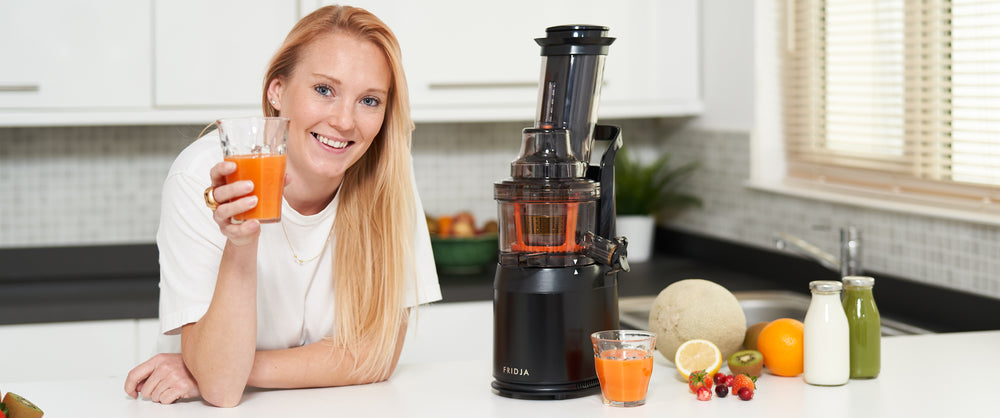
The f2500 Self Feeding Whole Fruit Juicer was developed around this idea of reducing effort. Its 135mm self-feeding chamber is wide enough to accept whole apples, large carrot pieces and generous handfuls of leafy greens without meticulous chopping.
No slicing everything down to size.
No feeding pieces one by one.
You place ingredients into the chamber, close the lid and let the slow press system do the rest.
Cleaning Without the Chore
If preparation is the first barrier, cleaning is usually the second. Cold press juicers are often perceived as complicated to clean, especially when fine mesh filters require careful scrubbing after every use.
The f2500 was designed to simplify this stage as well. By reducing the number of components and avoiding a delicate mesh basket that demands extended cleaning time, the process becomes more straightforward. The main parts are dishwasher safe, and the overall assembly is intuitive to dismantle and reassemble.
Fewer parts.
No delicate mesh filter.
Dishwasher-safe components.
Cleaning takes minutes rather than feeling like another job at the sink. Over time, that simplicity encourages continued use. A juicer that is easy to clean is far more likely to remain on the worktop.

Slow Cold Press, Smoother Results
Operating at 60RPM, the f2500 gently presses ingredients rather than shredding them at high speed. This slower extraction reduces heat and oxidation, helping preserve flavour and texture while producing juice that is typically smoother and less foamy.
Less heat.
Less foam.
Quieter mornings.
The slower motor also makes the machine noticeably calmer than centrifugal alternatives. The emphasis is not on speed for the sake of it, but on steady, consistent performance that fits naturally into a family kitchen.

Designed for Everyday Kitchens
The f2500 is not positioned as a commercial machine, and it is not intended to feel like specialist equipment. It was developed for ordinary households that want fresh juice to become part of everyday life without turning the kitchen into a production line. It handles hard fruits, root vegetables, leafy greens, peeled citrus, pomegranate and wheatgrass with ease, offering flexibility across the week rather than limiting you to one type of recipe.
It can also be used to prepare vegan nut milks and simple fruit sorbets, which broadens its role beyond morning juice. Almond or cashew milk made fresh at home feels different from the boxed versions in a supermarket fridge, and frozen fruit pressed slowly into a smooth sorbet requires nothing more than good ingredients. The machine adapts quietly, without asking for more effort from you.
That versatility matters, but it is not the main point. The real difference lies in how naturally the f2500 fits into daily life. Because it removes the need for extensive chopping and simplifies the cleaning process, it addresses the two most common reasons juicers go unused. When preparation is minimal and clean-up is manageable, the barrier to using it again tomorrow disappears.
In the end, more families are switching to self-feeding cold press juicing not because it is a trend, but because it feels sustainable. It is a calmer, more practical way to make fresh juice, nut milks and fruit sorbets at home. And when something feels easy enough to repeat, it becomes part of the routine rather than an occasional effort.
If fresh juice is something you want to make part of everyday life rather than something you start and stop, the difference becomes clear.
Normaler Preis
€169,99 EUR
Verkaufspreis
€169,99 EUR
Normaler Preis
€179,99 EUR
Stückpreis
pro
inkl. MwSt.
Versand wird beim Checkout berechnet
Auf Lager
- Fully secure checkout
- Free
Shipping - Bewertet und rezensiert
Der Fridja f2500 Self Feeding Whole Fruit Juicer ist so konzipiert, dass er sich mühelos in Ihren Tagesablauf einfügt. Geben Sie ganze Früchte hinein, schließen Sie den Deckel und fahren Sie mit Ihrem Morgen fort. Kein Zerkleinern, kein Schieben und kein Lärm. Einfach nur sanfter, kalt gepresster Saft, während Sie Ihren Tag fortsetzen.
Ein ruhigerer, sauberer Start in den Tag. Frischer Saft ist vollgepackt mit Vitaminen und Antioxidantien und unterstützt Energie, Verdauung und Hautgesundheit. Sie können auch Nussmilch, Sorbets und Fruchteis ohne Zusatzstoffe oder Aufwand herstellen. Einfach zu bedienen, einfach zu reinigen und einfach immer wieder zu verwenden. Das ist tägliches Wohlbefinden leicht gemacht.


Customer Reviews
Overall rating: 4.7 / 5 from 4502 reviews.
Very very smooth and it’s very easy to wash too.
Very easy to dismantle, clean and put back together. The pulp is also quite dry which means I'm getting a high juice yield.
A fast and efficient delivery. The air fryer/ oven lived up to expectations. I use it daily and it works well. It looks good too and fits in with my kitchen . It was reasonably priced too.
Works well Very happy with my purchase
Me gusta como funciona... es fácil, cómodo y además los zumos quedan geniales.
My son broke the first lid so needed a replacement. I ordered one from Frija. Works perfect. Only downside is - it's expensive.
Very well built little oven, perfect for using in our new van build. Powerful and versatile but not power hungry. Very happy with the purchase and the results.

Top. Top
The steamer is a great product and perfectly light for travelling and takes the creases out of everything
Thanks for sending the replacement quickly. it was undamaged.
A very high quality product which does the job well. It is not difficult to clean but there are three quite large complex parts and two jugs to wash up after use. So it’s not really ideal for making a glass or two of juice. You really need to be making and storing a bottle of it which will last a few days. The filters are very easy to clean and it’s quiet and powerful. The pulp is very dry and the design of the two spouts and jugs is excellent.
Not had a hand held steamer before. Very pleased so far but still getting used to it. Delivery was let down by DPD where, apparently the box was damaged at the depot and arrived at my doorstep with an open and ripped box. Thank you Fridja for the no quibble offer to send me the missing instructions and carry bag.
Very good product
Really pleased with this. Great for juices. Still experimenting with the sorbet/ice cream as you seem to have to make a lot for it to work well. But overall really happy.
Really pleased with it. Quick and easy to use. So neat to look at. No fuss. would recommend to everyone thinking about it
So far so good, cooks really quickly and is easy to keep clean.
Ich schnell angekommen und konnte bis jetzt einige Funktionen ausprobieren und bin mit den Resultaten sehr zufrieden. Das Essen wird sehr schnell schnell sehr knusprig und lecker.
Good

The juicer works well, solid structure. The pulp comes out nicely dry, extracted juices are tasty and rich. The machine is easy to set up. The pouring jars are easy to use. I'm happy with it. Thanks:)
Haven't used it yet, but when I do i will let you know I'm away at the moment, looks good though
Saw great reviews on youtube. As I live in US and it is not available here, ordered it to arrive at Munich hotel during my business trip. Was waiting for me. Love it!
Va fenomenal y súper silencioso
Absolutely blown away! ⭐⭐⭐⭐⭐ I upgraded from a very old Philips juicer that I’d had for years, and I am absolutely blown away by the difference! I can genuinely taste the individual fruits and vegetables I’m juicing. The flavour is just incredible! It’s quiet, quick, easy to use and, best of all, so easy to clean. I honestly couldn’t be happier with it. An absolutely amazing product that I’d highly recommend to anyone who enjoys juicing or is thinking about getting started!
If like juice, by this juicer. It’s the real deal.
Great!

Siempre he odiado la plancha de ahora en unos minutos mis camisas y mis pantalones quedan perfectos

It was good lovely infant this is fantastic this juice g2500 is ever thing that had happened to me I had different juices fruit everyday such as cucumber orange celery PEANAPLE apple juice and apple grape
⭐⭐⭐⭐⭐ Really pleased with my Fridja handheld clothes steamer! It heats up quickly, is easy to use and removes creases from clothes really well. It’s lightweight, convenient and saves so much time compared to ironing. Perfect for freshening up outfits quickly, especially when you don’t want to get the ironing board out. Excellent after-sales service. Really impressed with the follow-up after my purchase. Great customer service and a company that clearly cares about its customers. Would happily recommend Fridja! I have had one for years and bought a second one for my daughter at University. Throughly impressed.
Brilliant piece of kit. Easy to use - fruit goes in whole. Easy to clean too
Great product
All good am very happy with my refurbished product.
Only used twice but so far so good

I brought it has a gift. I had to see if it was any good. 10/10 . Excellent very happy with it. Going to buy one for myself now.
I had bought a Fridja juicer in 2020 and use it frequently. My aunt came to stay loved it, so we bought her one as a gift
Excellent product does exactly what it says it does, so easy to use and the clothes look great. It’s easy to use ordering was simple and the delivery was great
Good service. Prompt. Saved buying a new one.
It really is very good! The only downside is that it could use some sort of handle or gripper to insert and remove the baking tray and other accessories—which get very hot—making them easier to handle.
This is the first steamer I've bought. I did a lot of research and this one seemed to be the best for quality and value for money. I was specifically looking for one that could tackle thick cotton and linen. It's done an OK job, however, I think this was more to do with the operator than the steamer itself. It was really easy to set up.
Bought for a wedding abroad. Was used as a trial before I left and again on morning of wedding. Was impressed