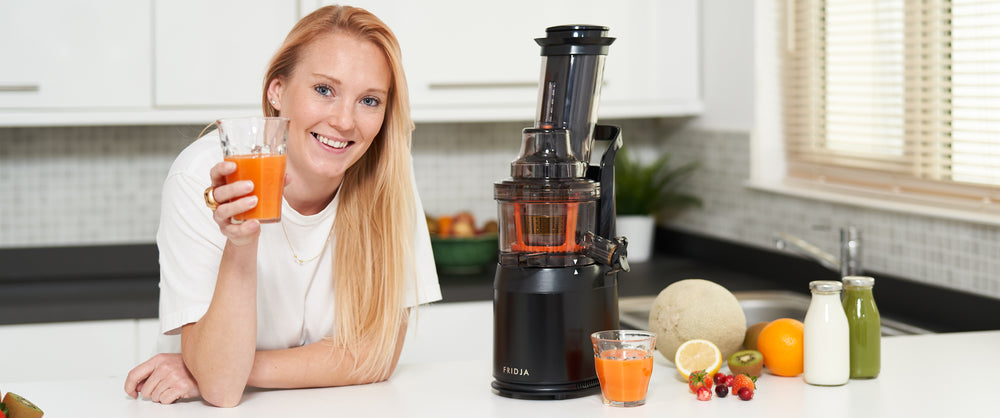


If you have ever fed a handful of spinach into a juicer only to watch it whirl around, clog up, or produce barely half a glass, you already know why finding the best juicer for leafy greens takes more than picking the first sleek machine you see. Greens are light, fibrous and sometimes frustrating, so the right juicer needs to handle them efficiently without turning your morning routine into a chore.
For most households, that means looking past flashy extras and focusing on what actually improves daily use - steady juice yield, easy prep, straightforward cleaning and a design you will be happy to keep on the worktop. If a juicer feels fiddly, bulky or messy, it tends to end up in the cupboard. And no appliance improves your routine from the back of a cupboard.
What makes the best juicer for leafy greens?
Leafy greens behave differently from apples, oranges and carrots. They are softer, less dense and packed with long fibres, which means they need a juicing method that presses and squeezes rather than simply blitzing at speed. That is why slow juicers usually come out ahead when greens are the priority.
A centrifugal juicer can be quick for hard fruit and veg, but with kale, spinach, chard and wheatgrass, speed is not always your friend. Fast-spinning blades often struggle to grab light leaves properly, and the result can be wetter pulp, lower yield and more froth. If you mostly want green juices, that trade-off rarely feels worth it.
A slow juicer, also called a cold press or masticating juicer, works at a gentler pace to crush produce and extract more juice from fibrous ingredients. In practical terms, that usually means better results from leafy greens, less waste in the pulp container and a cleaner-tasting juice. It also tends to be quieter, which matters if you are making juice before work while the rest of the house is still waking up.
Slow juicer or centrifugal juicer?
If you are choosing between the two, the honest answer is simple. For leafy greens, a slow juicer is usually the better buy.
That does not mean centrifugal models have no place. If you mainly juice apples, carrots and citrus and only add the occasional handful of spinach, a centrifugal machine may still suit you. They are often fast and familiar, and some shoppers prefer that convenience. But if your regular shopping basket includes kale, celery, cucumber, parsley or mint, a slow juicer is far more likely to give you the result you actually want.
This is one of those it-depends decisions. The best juicer for leafy greens is not necessarily the best juicer for every household. It depends on what you juice most, how often you use it and how much effort you are willing to put into prep and cleaning.
Features worth paying for
When you compare juicers, it is easy to get distracted by big claims and technical language. A few details matter far more than the rest.
A strong auger system is one of them. This is the part that pulls in produce and presses out the juice. With greens, you want an auger that grips leaves properly instead of letting them spin uselessly inside the chamber. That alone can make the difference between a satisfying glass and a disappointing dribble.
A wide enough feed chute also helps, although there is a balance to strike. A very wide chute can reduce prep time, which is great on busy mornings, but performance still matters more than opening size if greens are your main focus. Leafy veg often still needs bunching or combining with firmer ingredients to move through cleanly.
Cleaning should be high on your list too. People often underestimate this until the first week of ownership is over. If the strainer is awkward, the pulp gets trapped in hard-to-reach corners, or there are too many parts to rinse, daily juicing quickly starts to feel like a weekend-only habit. A good juicer for greens should be easy enough to clean without negotiation.
Noise level is another practical point. Slow juicers tend to be quieter than centrifugal models, which makes them easier to live with in smaller kitchens or shared homes. And because many design-led kitchens keep appliances on display, appearance is not a trivial extra either. A machine that looks smart and feels compact is more likely to earn a permanent spot on the counter, which usually means it gets used more often.
The ingredients you juice matter more than you think
Not all greens are equally demanding. Spinach is soft and easy to compress but can produce less dramatic yield than people expect. Kale is sturdier and often juices well in a capable slow machine. Parsley, mint and wheatgrass are more specialised and can reveal weaknesses in a lower-performing juicer very quickly.
This matters because many people do not juice greens on their own. More often, they combine them with cucumber, apple, celery, lemon or ginger to create a drink that tastes fresher and runs more smoothly through the machine. In those cases, the best juicer for leafy greens is one that handles mixed ingredients confidently, rather than excelling with one type of leaf and struggling with everything else.
If your usual recipe is spinach, cucumber and apple, you need a machine that can switch from delicate leaves to watery veg and firmer fruit without constant stopping and starting. That is where thoughtful engineering makes everyday use feel simple instead of temperamental.
What to avoid when shopping
Very cheap juicers can look tempting, especially if you are trying green juice for the first time. But this is one category where a bargain can become expensive in frustration. Poor extraction, frequent clogging and awkward cleanup usually lead to less use, not more value.
Be wary of models that promise to do everything but say very little about leafy greens specifically. Greens are often treated like a bonus feature in broader juicer marketing, when in reality they require a particular kind of performance. If a machine is mainly designed around hard produce and speed, it may underdeliver once the kale comes out.
It is also worth avoiding anything oversized for your actual routine. A large appliance with a big footprint can be useful for families, but if you live in a flat or have limited worktop space, compact convenience may matter more than maximum capacity. The best option is the one that fits your kitchen and your habits, not just the one with the longest feature list.
How to choose the right model for your routine
The easiest way to narrow it down is to think about frequency first. If you plan to juice most days, prioritise ease. You want a machine that sets up quickly, cleans without fuss and feels reliable enough for regular use. If juicing is more of a few-times-a-week habit, you may be happy to accept a little more prep for a lower price.
Then think about the kind of recipes you actually make. A greens-only buyer should focus on slow extraction and efficient pulp removal. A mixed-juice household should look for a balanced machine that handles leafy greens well but also copes comfortably with apples, beetroot and citrus.
Finally, consider whether the machine fits the rest of your kitchen life. Busy households usually get more value from appliances that are intuitive, tidy and pleasant to use. That is why design matters alongside performance. A juicer should feel like a practical upgrade to your routine, not another task to manage.
If you are looking at specific models, the f1900 Whole Fruit Juicer and the f2500 Self Feeding Juicer are both worth considering for green juice use - the f2500 in particular suits households that want to minimise prep time. The f2800 Open Juicer is a good option if you prefer a more open feed design. For those wanting to cover both whole fruit and citrus in one setup, the Juicer Duo pairs the f1900 with the f900 Automatic Citrus Juicer.
Is the best juicer for leafy greens always the most expensive?
Not necessarily. Higher-priced models often offer better materials, stronger extraction and nicer finishing touches, but price alone does not guarantee the best fit. Some premium machines are excellent for dedicated juicing enthusiasts who want maximum control, while others include extras that sound impressive but add little for the average home user.
For most people, the sweet spot is a well-designed slow juicer that performs consistently with greens, does not dominate the kitchen and is easy to clean after a weekday breakfast. That is where real value sits. A machine that gives you good juice and gets used four times a week is a better buy than a costly statement appliance that feels too inconvenient to reach for.
The right choice should make healthy habits easier to keep. If your juicer can turn a bag of spinach, a cucumber and a couple of apples into a fresh glass with minimal mess, it is doing its job properly.
Choosing the best juicer for leafy greens comes down to one simple question: will this make green juice easy enough to enjoy regularly? If the answer is yes, you are far more likely to keep using it - and that is what makes a good buy feel worthwhile long after the first glass.