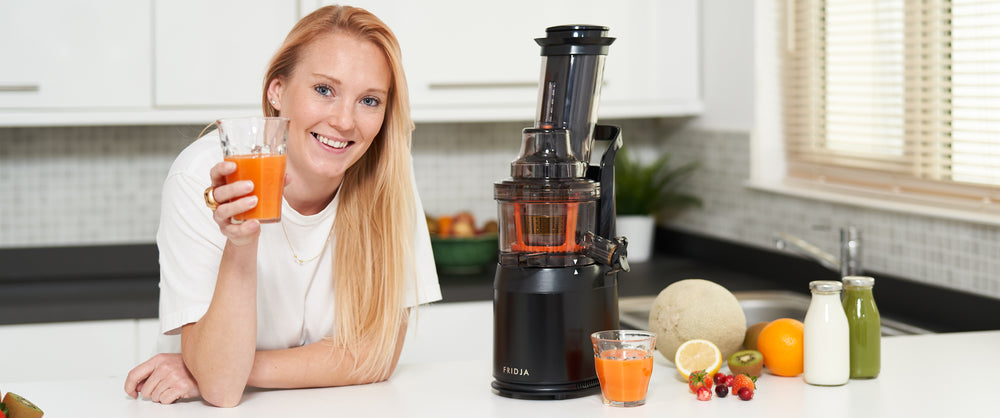


A self-feeding juicer takes most of the effort out of juicing: you fill the hopper, close the lid and let it work. But how much juice you actually get from a bag of apples still depends on what you put in and how you put it in. Two people with the same machine can end up with noticeably different glasses from the same shopping.
These self-feeding juicer tips are about getting more juice and less waste from every batch. They are based on how slow juicers work, so they apply to any self-feeding model, with notes on the f2500 Self Feeding Whole Fruit Juicer where it helps. If you are new to this type of machine, our explainer on how self-feeding juicers work is a good place to start.
Why yield varies
A slow juicer uses an auger, a screw-shaped part that turns slowly, to crush produce and press it against a fine strainer. Juice passes through; pulp is pushed out separately. On the f2500, a 250W motor turns the auger at 50RPM. Yield depends on three things:
- The produce itself: how ripe, how fresh and how watery it is.
- How it reaches the auger: a steady, firm feed presses well; a soft or tangled feed does not.
- The condition of the strainer: a clogged strainer lets less juice through.
Get those right and the machine does the rest.
1. Choose ripe, firm produce
Ripeness is the biggest single factor. Fruit that is ripe but still firm gives the most juice with the best flavour. Underripe fruit is hard and dry and tastes sharp. Overripe fruit turns mushy, and soft flesh tends to become purée that clogs the strainer rather than separating into juice and dry pulp.
- Apples and pears: pick firm, crisp ones. A soft, floury apple gives less juice and a thicker, cloudier glass.
- Carrots and beetroot: look for firm roots that snap rather than bend.
- Citrus: heavy for its size usually means juicy.
- Greens: crisp leaves juice far better than limp ones.
Fresher produce also has more water in it. A bag of carrots that has been in the fridge drawer for three weeks will give less than a fresh bunch.
2. Prep a little, not a lot
The point of a self-feeding juicer is less chopping, and the f2500's 135mm feeding chute takes most apples and pears whole. A small amount of prep still helps the yield:
- Remove stalks, stones and tough stems. Stones in plums, cherries and mangoes must come out.
- Halve anything that only just fits. Fruit that sits snugly in the hopper can sometimes wedge rather than feed.
- Peel thick-skinned citrus. The peel is bitter and tough, and the pith adds bitterness too. Leaving a little pith is fine.
- Cut fibrous stalks into shorter lengths. Celery and rhubarb strings can wrap around the auger. Pieces of around 5cm feed more cleanly.
- Peel pineapple and remove the core, then cut it into chunks.
3. Load the hopper in the right order
Loading order matters more than most people expect. The auger works best when it always has something firm to grip, so build each batch with hard and soft produce mixed together.
- Start with something firm, such as an apple or a few carrots, at the bottom.
- Add leafy greens in the middle, rolled into tight bundles and sandwiched between firmer pieces. The firm produce pushes the leaves through.
- Put small, strong-flavoured items in between, such as a thumb of ginger, a slice of lemon or a few mint leaves, so they are pressed along with everything else rather than sitting on their own.
- Finish with something firm on top, which helps push the last of the softer produce down.
Do not overfill past the maximum line. A full hopper is fine; a crammed one can stop the produce feeding evenly.
4. Go easy on soft fruit
Very soft fruit such as bananas, avocados, ripe mangoes and very ripe berries does not juice well in any slow juicer. It turns to pulp and smothers the strainer. If you want those flavours, juice the firm ingredients first and then blend the soft fruit into the finished juice, or save them for a smoothie.
Berries and grapes work better mixed with firm fruit such as apple than juiced on their own.
5. Juice leafy greens the smart way
Slow juicers handle greens much better than fast centrifugal machines, but greens are still light and fibrous. To get the most from spinach, kale or herbs:
- Roll the leaves into tight balls or bundles.
- Always sandwich them between firm produce.
- Remove thick kale stems, which are tough and stringy.
- Do not juice a hopper full of greens on their own.
Our guide to the best juicer for leafy greens has more on what makes greens juice well.
6. Let it finish the batch
It is tempting to switch off as soon as the hopper looks empty, but there is often still produce working through the chamber. Let the machine run until juice stops dripping from the spout and the pulp outlet goes quiet. On the f2500, the anti-drip tap helps keep the worktop clean once the last drops have run through.
7. Keep the strainer clear
A strainer clogged with fine pulp lets less juice through, and you may see more juice coming out with the pulp. For large batches:
- Juice fibrous and soft produce in smaller loads, with firm produce between them.
- If the flow slows noticeably, stop, rinse the strainer and carry on.
- Clean the strainer thoroughly after every session, before the pulp dries. A dedicated juicer cleaning brush reaches into the fine mesh far better than a sponge.
Worn parts can also affect performance over time. If your auger or seal ring is damaged, replacements are available in our f2500 spare parts range.
8. Check your pulp
Your pulp is the best guide to how well a batch has gone. Squeeze a handful over the sink:
- Dry and crumbly: the machine is pressing well and there is little more to get.
- Damp and drips when squeezed: the produce may be too soft, the strainer may be clogging, or the batch had too many greens without firm produce.
You can put damp pulp through a second time, but if it comes out dry, there is little to gain. Rather than throwing it away, our list of ways to use juice pulp has ideas from muffins and crackers to compost.
9. Measure, then adjust
If you want to get serious about yield, weigh your produce before juicing and measure the juice afterwards with a measuring jug. The f2500's juice jug holds 1 litre, which makes a handy guide. Do this for a few batches and you will soon learn which fruit gives the most juice from your shopping, how ripeness changes things and whether a new loading order makes a difference.
Storing juice so none goes to waste
Fresh juice tastes best straight away. If you make a larger batch, pour it into a clean, airtight bottle, fill it close to the top to limit air, and keep it in the fridge. Fridja suggests juice from the f2500 keeps for up to 72 hours in an airtight container in the fridge, though flavour and colour are best in the first day. A squeeze of lemon helps slow browning in apple and pear juice.
A balanced note
Fresh juice is an enjoyable way to have more fruit and vegetables, but it is not a replacement for eating them whole. Juicing removes most of the fibre, and fruit juice counts towards free sugars. The NHS suggests no more than 150ml of fruit juice and smoothies combined a day. Vegetable-heavy juices with a little fruit for sweetness keep the sugar down and still taste good.
Putting it together
For a typical batch: wash firm, ripe produce, remove stones and tough stems, peel citrus, roll greens tightly, and load the hopper hard, soft, hard. Let the batch finish, check the pulp and clean the strainer straight after. That routine takes a couple of minutes and makes a real difference to how much ends up in the glass.
Looking for something to try? Our autumn juice recipes make the most of apples, pears and beetroot while they are in season. If you are still choosing a machine, the f2500 is a Which? Best Buy, and if you want the widest opening for whole fruit, the f2800 Open Whole Fruit Juicer has a 180mm open chute. You can compare the full range in our juicers collection.