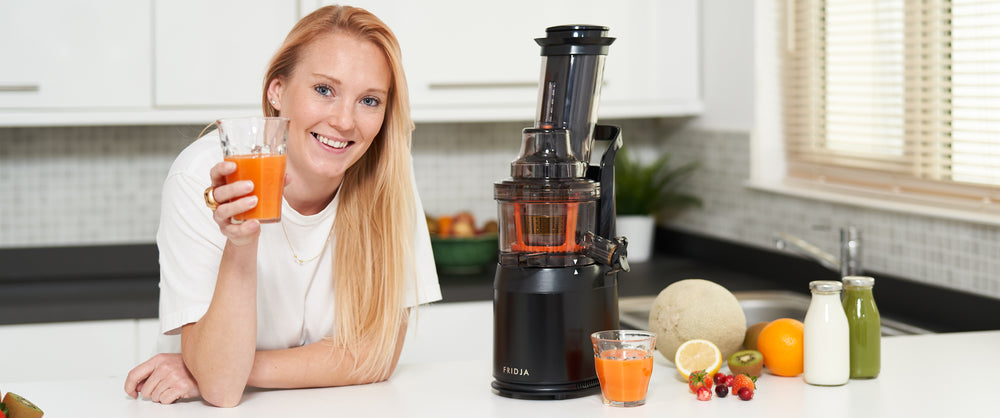


Most people who give up on juicing do not give up because they stop liking juice. They give up because of the chopping, the standing over the machine pushing fruit down a narrow tube, and the washing-up afterwards. A self-feeding juicer is designed to remove the first two of those problems almost entirely.
This guide explains what a self-feeding juicer is, how it works inside, what it does well, where it has limits, and how to tell whether it fits your kitchen. If you are weighing one up against a conventional slow juicer or a fast centrifugal model, it should help you decide.
What is a self-feeding juicer?
A self-feeding juicer is a slow, or masticating, juicer with a large hopper on top. Instead of feeding pieces of fruit one at a time through a narrow chute and pressing them down with a pusher, you load the hopper with whole or roughly halved produce, close the lid and press start. The machine draws the produce down into the juicing chamber by itself while you get on with something else.
In other words, the "self-feeding" part refers to how the produce gets from the hopper to the auger, not to how the juice is extracted. Underneath, it is still a cold-press juicer that crushes and presses fruit and vegetables slowly.
How a self-feeding juicer works
The hopper
The hopper is the wide container at the top. Its size is what makes whole-fruit juicing possible. On the f2500 Self Feeding Whole Fruit Juicer, the feeding chute is 135mm wide, so most apples, pears and oranges go in without cutting. The f2800 Open Whole Fruit Juicer goes further with a 180mm open chute.
The feeding mechanism
Inside the hopper, the design guides produce downwards towards the auger in a steady flow. Gravity does some of the work, and the shape of the hopper and the turning parts below do the rest. This is why you can load it up and walk away rather than standing there with a pusher.
The auger
The auger is the screw-shaped part at the heart of any slow juicer. It turns slowly, crushing produce and pressing it against a fine strainer. The f2500 uses a 250W motor with the auger turning at 50RPM, while the f2800 works at 45 to 47RPM. That slow speed is the defining feature of a cold-press juicer.
The strainer and outlets
Juice passes through the strainer and out of the juice spout, while the drier pulp is pushed out of a separate outlet into its own container. On the f2500, a 1 litre juice jug sits under the spout, and an anti-drip tap helps keep the worktop clean between glasses.
Self-feeding vs traditional slow juicers
Both types use the same slow pressing method, so the differences are mostly about convenience.
- Prep time. A traditional slow juicer often needs fruit cut into small pieces to fit a narrow chute. A self-feeding juicer takes whole or halved produce, which can turn ten minutes of chopping into one or two.
- Hands-on time. With a narrow chute you feed and push throughout. With a self-feeding hopper you load once and leave it.
- Batch size. A large hopper holds enough for a couple of glasses in one go, which suits households who juice for more than one person.
- Footprint. The taller hopper can make a self-feeding juicer taller overall, so check the space under your wall cupboards.
Self-feeding vs centrifugal juicers
Centrifugal juicers use a fast-spinning blade and mesh basket. They are quick, but they tend to be loud, struggle with leafy greens and produce frothier juice. A self-feeding slow juicer takes longer to run, but it is far quieter, handles greens such as spinach and kale well, and gives a smoother juice with less foam. If you want to understand the nutrition side, our article on whether slow juicers are healthier than centrifugal juicers looks at what the evidence does and does not show.
What a self-feeding juicer does well
- Whole apples and pears. These are ideal hopper fillers. Wash, remove any stalks and drop them in.
- Mixed batches. Layer soft and hard produce together, such as apple, carrot and a piece of ginger, and let the machine work through them.
- Leafy greens. Slow pressing suits greens well. Roll leaves into a bundle and sandwich them between firmer produce.
- More than juice. Fridja slow juicers can make nut milk from soaked nuts, and the f2500 can also make sorbets and fruit ice creams. The f2800 includes a sorbet attachment for frozen fruit.
- Quiet mornings. Slow juicers are much quieter than blenders or centrifugal models, which matters in flats and early starts.
The honest limits
A self-feeding juicer is a big step forward in convenience, but it is not magic. It helps to know the limits before you buy.
- Some prep remains. Very large produce still needs halving, pineapples need peeling and coring, and stones in fruit such as mangoes and plums must come out.
- Citrus needs peeling. Thick citrus peel is bitter and tough on any slow juicer. Peel oranges first, or use a dedicated citrus juicer if you drink a lot of orange juice.
- Very soft fruit can be messy. Bananas and avocados do not juice well. Blend them into smoothies instead.
- It still needs cleaning. Fewer parts help, and the f2500's components are dishwasher safe, but a quick rinse straight after juicing is still the easiest habit.
Is a self-feeding juicer right for you?
If your mornings are rushed
Being able to load the hopper and leave it while you make breakfast is the main reason to choose one. Our realistic weekly juicing routine shows how that fits into a normal week.
If your last juicer gathers dust
If you own a juicer that lives at the back of a cupboard because it was too much effort, self-feeding is the feature most likely to change that.
If you juice for several people
A big hopper makes it easier to juice enough for the whole household at once without refilling every few seconds.
If chopping and pushing are hard work
Less chopping and no pushing makes juicing easier for people who find knives or repeated pressing awkward.
When something else makes more sense
If you only ever want a small glass of orange juice, a citrus juicer will be quicker and cheaper. And if you mostly drink smoothies with whole fruit, a blender may be the better fit.
f2500 or f2800: which hopper style?
The f2500 is a Which? Best Buy. It has a 135mm chute, a self-feeding design, a quiet 250W motor at 50RPM and dishwasher-safe parts, and it is a good match for most households who want hands-free juicing with a closed lid. The f2800 has a wider 180mm open chute and a self-feeding hopper, slow 45 to 47RPM extraction, an easy-clean filter and an included sorbet attachment, so it is the one to pick if you want to drop in the largest whole fruit with the least preparation. Our guide to choosing the best kitchen juicer compares the options in more detail, and you can see the full range in our juicers collection.
Getting the best results
- Wash produce well and remove large stones, stalks and tough peel.
- Load hard and soft produce together so the auger always has something firm to grip.
- Do not overfill past the maximum line. A full hopper is fine; a crammed one can stall the feed.
- Drink your juice fresh. Flavour is best straight away, and juice is best kept chilled in a sealed container if you make it ahead.
- Rinse straight after use. Pulp is far easier to remove before it dries.
- Use the pulp. Our list of ways to use juice pulp has ideas from muffins to compost.
A note on health
Fresh juice can be a tasty way to enjoy more fruit and vegetables, but it is not a replacement for eating them whole. Juicing removes most of the fibre, and fruit juice counts towards free sugars. The NHS suggests keeping fruit juice and smoothies to a combined total of 150ml a day. Vegetable-heavy juices with a little fruit for sweetness are a sensible way to keep the sugar down.
The bottom line
A self-feeding juicer keeps everything good about slow juicing, including quiet running, smooth juice and the ability to handle greens, and takes away most of the effort. If convenience is what stands between you and a regular glass of fresh juice, it is the feature worth paying attention to. For seasonal ideas to try first, see our autumn juice recipes.