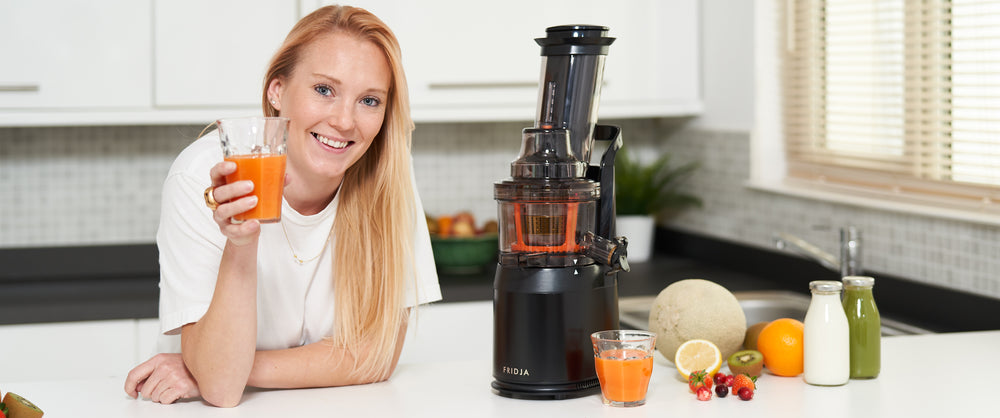

If you are asking yourself which juicer you should buy, the honest answer is that it depends less on the juice and more on your mornings. All three Fridja slow juicers press fruit and vegetables gently and make nut milk as well as juice. Where they differ is how much prep they need, how they feed, how big they are and how much time you want to spend at the worktop. This guide compares the f2500 Self Feeding Whole Fruit Juicer, the f2800 Open Whole Fruit Juicer and the f1900 Whole Fruit Juicer side by side, so you can pick the one that suits the way you actually live.
The short answer
- Choose the f2500 if you want to load whole fruit, close the lid and walk away. It is a Which? Best Buy.
- Choose the f2800 if you want the least chopping possible. Its 180mm open chute is the widest in the Fridja range, and it comes with a sorbet attachment.
- Choose the f1900 if you are happy to feed the juicer by hand and want a slim, stainless steel machine at a lower price.
How the three juicers compare
All three are masticating (cold press) juicers. Instead of shredding produce with a fast spinning blade, a slow auger squeezes it against a filter. That means less foam, less heat and a quieter machine. Here are the key numbers from each product page.
- Feed chute: f2500 135mm self-feeding hopper; f2800 180mm open self-feeding chute; f1900 just under 80mm, fed by hand.
- Motor and speed: f2500 250W at around 50 RPM; f2800 250W AC motor at 43 to 50 RPM; f1900 240W at 55 RPM.
- Size: f2500 21 x 19.5 x 43.7cm and 3.8kg; f2800 25.1 x 18.6 x 44.2cm and 5.7kg; f1900 15cm wide, 20cm deep and 49cm tall.
- Extras: f2500 anti-clog reverse function and anti-drip tap; f2800 sorbet attachment, juice sieve and food pusher; f1900 pulp sieve and stainless steel body.
- Also makes: all three make nut milk, sorbets and fruit ice cream. The f1900 product page also lists nut butters.
The f2500: load it, close it, walk away
The f2500 is the juicer we point most people towards first. You drop whole apples, pears and carrots into the 135mm hopper, close the lid and switch it on. The machine feeds itself, so there is no pushing and no standing over it while it works. You can load it, make the toast and come back to a jug of juice.
Because the lid stays closed while it runs, the f2500 is a sensible choice for kitchens with children around. The anti-drip tap holds juice in the chamber until you open it, which is handy if you like to mix two or three ingredients before pouring. Every part is BPA-free, and the detachable parts are dishwasher safe below 40°C.
It is also shorter and much lighter than the f2800. Our guide to how self-feeding juicers work explains the hopper and auger in plain terms.
Best for: anyone who wants fresh juice most mornings with the least effort, and anyone buying their first slow juicer.
The f2800: the widest chute in the range
The f2800 takes the self-feeding idea and opens it right up. Its 180mm open chute swallows whole apples, oranges and pears, so prep time drops even further. Gravity pulls ingredients down, so you can fill it and step away.
It comes with more in the box: a frozen fruit sorbet attachment, a fine juice sieve, a pusher shaped like a spatula and a cleaning brush. The open mesh filter is designed to rinse clean under the tap, and Fridja says the whole machine can be cleaned in under a minute. Most parts are top-rack dishwasher safe up to 40°C, although hand washing helps the silicone seals last longer.
The trade-off is size. At 5.7kg it is the heaviest of the three, so it suits a kitchen where it can stay put. You can read more about the design in our f2800 launch post.
Best for: households that juice a lot of large fruit, people who want sorbets as well as juice, and anyone who hates chopping.
The f1900: hands-on and slim
The f1900 is the more traditional slow juicer of the three. Its chute is narrower, so larger fruit may need cutting into halves or quarters, and you feed it by hand using the pusher. Some people enjoy that, as you control the order ingredients go in.
It has a 240W motor running at 55 RPM, a stainless steel exterior and BPA-free Tritan for key food contact parts. The included sieve lets you decide how much pulp ends up in your glass. At 15cm wide it takes up the least worktop space, although it is the tallest at 49cm, so check the clearance under your wall cupboards.
Best for: people on a tighter budget, small kitchens with tall clearance and anyone who does not mind a little prep.
Four questions to help you decide
- How much time do you have in the morning? If the answer is five minutes, a self-feeding model (f2500 or f2800) will get used far more often than one you have to stand over.
- What do you juice most? Big apples, oranges and pears favour the f2800's open chute. Mixed fruit and veg with leafy greens work well in any of the three.
- Where will it live? Measure the space under your cupboards. The f2500 is the shortest of the three; the f1900 is the narrowest.
- Who else is in the kitchen? With young children around, a closed lid during juicing is a sensible feature.
Cleaning: the part that decides whether you keep juicing
Most juicers end up in a cupboard because cleaning feels like a chore. All three Fridja models rinse under warm water with the supplied brush, and the habit that helps most is rinsing straight after juicing, before pulp dries on the filter. Our step-by-step guide on how to clean a slow juicer properly covers the details, and it applies to all three.
Getting value from your juicer
If you want to plan your shopping, our guide on how much fruit you need for a glass of juice gives realistic quantities. Fresh juice is a nice part of a varied diet, but the NHS suggests keeping fruit juice and smoothies to 150ml a day in total, and whole fruit still gives you more fibre.
If you would like a Fridja juicer for less, have a look at our refurbished range, which includes checked and tested juicers. You can also compare every model on the juicers collection page, or read our broader guide to choosing the best kitchen juicer.
Our verdict
For most homes, the f2500 is the one to buy: self-feeding, compact and rated a Which? Best Buy. For the least prep and sorbets too, the f2800 is worth the extra space. For a hands-on juicer with a slim footprint and a lower price, choose the f1900.
Frequently asked questions
Which Fridja juicer is best for beginners?
The f2500 is the easiest place to start. You load whole fruit into the 135mm hopper, close the lid and it feeds itself, so there is very little to learn. It is compact, the detachable parts are dishwasher safe below 40°C, and it was rated a Which? Best Buy, which gives first-time buyers some reassurance.
Is a self-feeding juicer worth the extra money?
If you juice regularly, usually yes. A self-feeding juicer saves you standing at the worktop pushing fruit through, and most of them need much less chopping. That convenience is what keeps people juicing week after week. If you only juice now and then and do not mind a bit of prep, a hand-fed model like the f1900 works well.
Can all Fridja juicers make nut milk?
Yes. The f2500, f2800 and f1900 all make nut milk as well as juice. Soak the nuts first, feed them in gradually with water and strain through a sieve for a smoother result. All three also make sorbets and fruit ice cream from frozen fruit, and the f2800 includes a dedicated sorbet attachment.
Do I need to peel and chop fruit for a slow juicer?
Less than you might think. The f2800's 180mm chute takes whole apples, oranges and pears, and the f2500's 135mm hopper takes many whole fruits too. Remove large stones, such as from mangoes and peaches, and peel thick citrus skins for better flavour. The f1900 has a narrower chute, so larger fruit needs cutting first.
Which Fridja juicer is the quietest?
All three are slow juicers, so they are much quieter than centrifugal machines with fast spinning blades. The f2500 and f2800 both run at around 50 RPM or less, and the f2800 uses an AC motor described as noticeably quieter than centrifugal juicers. Any of them should be fine for early mornings in a flat.